Stop Juggling 6 Tools: Why We're Building One Feedback Loop for SaaS Teams
It's not about putting six tools in one place. It's about closing the loop that none of them close.
 Ritik SharmaFounder, ChirpBack5 min read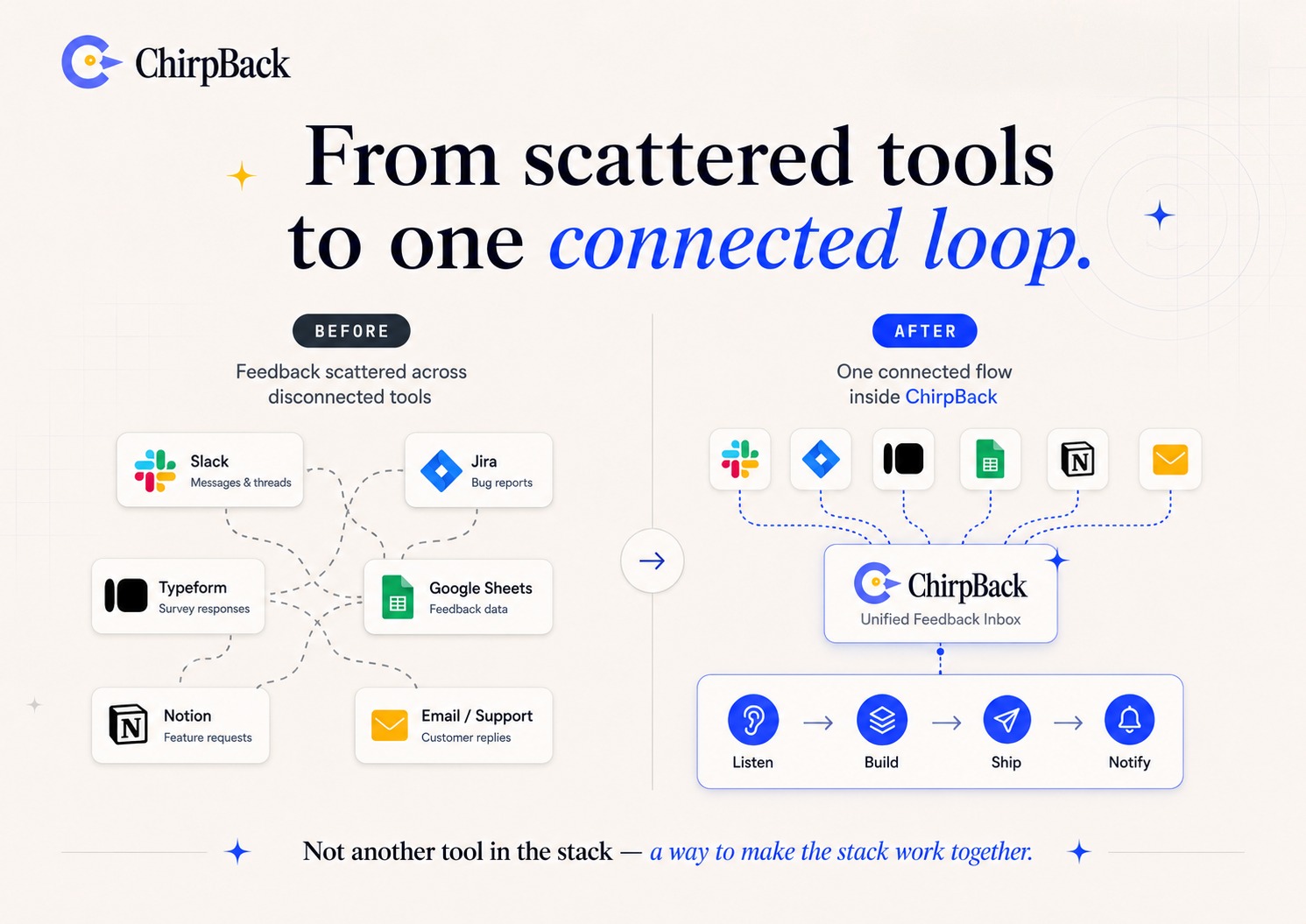
Every product team I've worked around has managed customer feedback across at least five or six places.
A widget on the website.
A Slack channel where someone drops, "Hey, a user asked for this."
A spreadsheet full of survey responses.
Backlog tickets in Jira or Linear.
App store reviews nobody checks often enough.
A changelog draft sitting somewhere in Notion, waiting to be published.
None of these tools are bad.
That's not the problem.
The problem is that feedback lives in all of them — and belongs to none of them.
It arrives in one place, gets discussed in another, maybe becomes a ticket somewhere else, and then most of the time, it quietly disappears.
For a long time, I thought the fix was better collection.
More channels.
Cleaner forms.
A nicer widget.
A better dashboard.
But that was never the real gap.
Most SaaS teams are not short on feedback. They are drowning in it.
The real gap is what happens after the feedback arrives.
The part everyone skips
Here's the moment that bothered me enough to start building ChirpBack.
A customer takes the time to write in.
They explain a real problem clearly. Someone on the team reads it. Maybe it even gets prioritized. Maybe it becomes a ticket. Maybe the team actually ships the exact thing that customer asked for.
And the customer never finds out.
They've already moved on.
Sometimes they've already churned — three weeks before the release of the feature that might have kept them.
The feedback was heard.
It was acted on.
It even shaped the product.
But the loop still never closed.
Because "telling the person who asked" was nobody's job.
And it didn't live naturally in any of the tools.
That's the thing I couldn't stop thinking about.
You can have the best feedback collection system in the world, but if the customer experiences silence at the end, the relationship still feels broken.
So no, this is not "six tools in a trench coat"
When I say ChirpBack brings feedback, surveys, public boards, backlog workflows, announcements, and analytics into one place, the fair reaction is:
Isn't that just bundling?
Isn't that trying to do too much?
It would be — if the goal was feature parity.
But that is not the goal.
The reason these workflows belong together is not tidiness. It is connection.
The feedback needs to know which backlog item it became.
The backlog item needs to know when it shipped.
And when it ships, the people who originally asked need to hear about it.
Not manually.
Not through someone remembering to export a list.
Not through three tools and a fragile Zapier chain.
The connection is the product.
That is the core idea behind ChirpBack.
What ChirpBack actually does
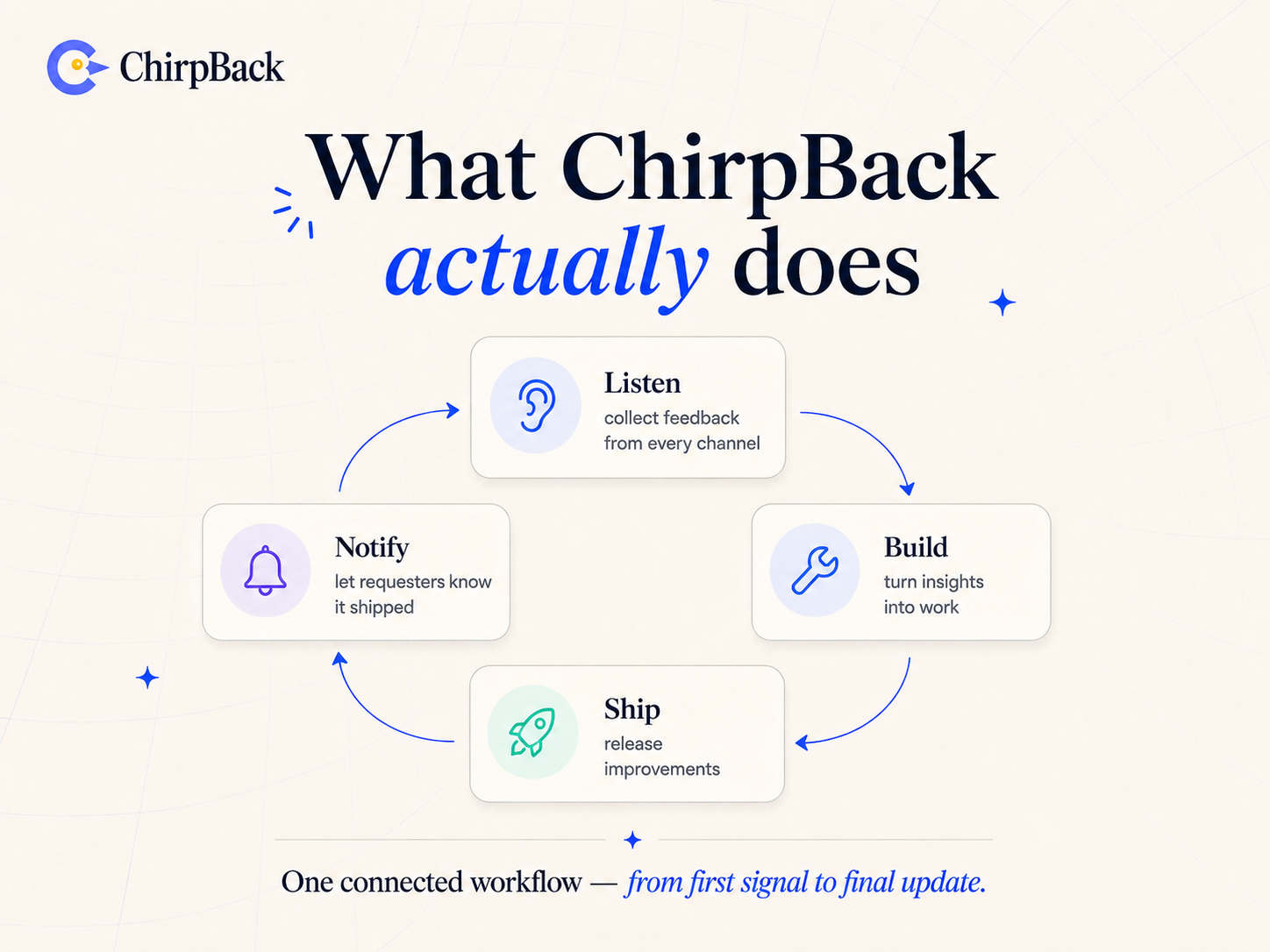
ChirpBack is built around one cycle:
Listen → Build → Ship → Notify
Listen
Feedback comes in from every channel into one inbox.
In-app widget.
Public board.
Surveys.
Email.
App store reviews.
Other sources teams already use.
One place to see what users are saying, instead of chasing signals across six tabs.
Build
Feedback can move into a backlog where teams can prioritize, group, assign, and connect it to real work.
If your team already works in Jira, Linear, Asana, Monday, or Trello, ChirpBack is not trying to replace that workflow.
It connects to it.
The point is not to create another disconnected backlog.
The point is to keep the original customer signal attached to the work.
Ship
When something moves forward, the feedback should not disappear into engineering language.
The team should still know:
Who asked for this?
Why did they ask?
How many people mentioned it?
Which feedback items shaped this decision?
That context matters.
Because without it, roadmaps become lists of tasks instead of responses to real customer needs.
Notify
This is the step most teams miss.
When the feature ships, the people who originally asked should hear from you.
Not months later by accident.
Not through a generic changelog they may never read.
But directly, because their feedback actually led somewhere.
That is the loop.
And that last step is the reason ChirpBack exists.
Everything else is in service of it.
Where Aero fits in
We're also building Aero, the AI assistant inside ChirpBack.
But Aero is not the pitch.
The pitch is still the loop.
Aero helps with the boring, repetitive work that usually slows teams down:
Summarizing hundreds of feedback items into themes.
Drafting announcements when something ships.
Helping build surveys from a simple goal.
Surfacing trends before someone manually digs through everything.
The goal is not to add AI for the sake of saying "AI-powered."
The goal is to remove the bottlenecks that stop teams from acting on feedback.
Because categorizing, summarizing, drafting, and connecting signals should not take more energy than actually listening to customers.
Why we're building this now
SaaS teams are already collecting more feedback than ever.
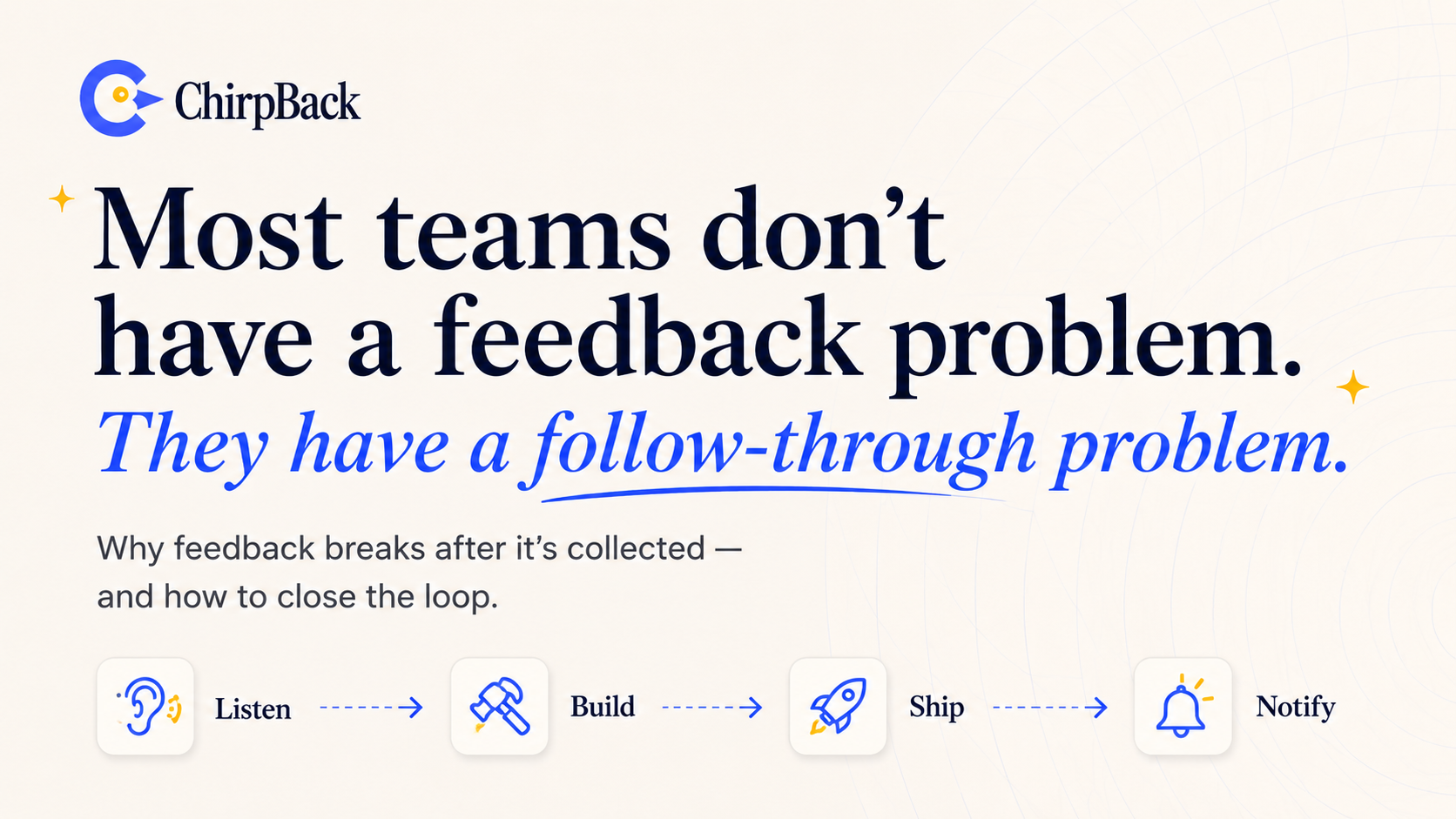
The problem is not access to customer voice.
The problem is follow-through.
A customer says something useful.
A team agrees it matters.
The work gets added somewhere.
Then the trail goes cold.
That broken trail creates real costs.
Product teams lose context.
Support teams lose trust.
Customers feel ignored.
Founders make decisions from scattered signals.
And good feedback dies quietly, even when the team had every intention of acting on it.
ChirpBack is our attempt to fix that.
Not by giving teams another place to collect feedback.
But by helping them connect the whole journey from the first signal to the final update.
The honest part
I've been building ChirpBack for almost two years.
Mostly nights and weekends. Around a full-time job. Solo.
I'm not going to pretend it is perfect.
It isn't.
But I would rather ship something real, learn from actual users, and improve it in public than keep polishing in private forever.
The idea is simple:
If customers take the time to tell you what they need, they should not disappear into a spreadsheet, a Slack thread, or a backlog ticket nobody connects back to them.
They should know when their feedback mattered.
That is what we are building.
ChirpBack launches on Product Hunt on June 2.
If you have ever watched a good piece of feedback die in a Slack thread — or shipped something a customer asked for and realized later they never knew — this is the exact problem we are trying to solve.
And if you check it out, I would genuinely love your feedback.
Even the critical kind.
That is the only kind that helps us close the loop.